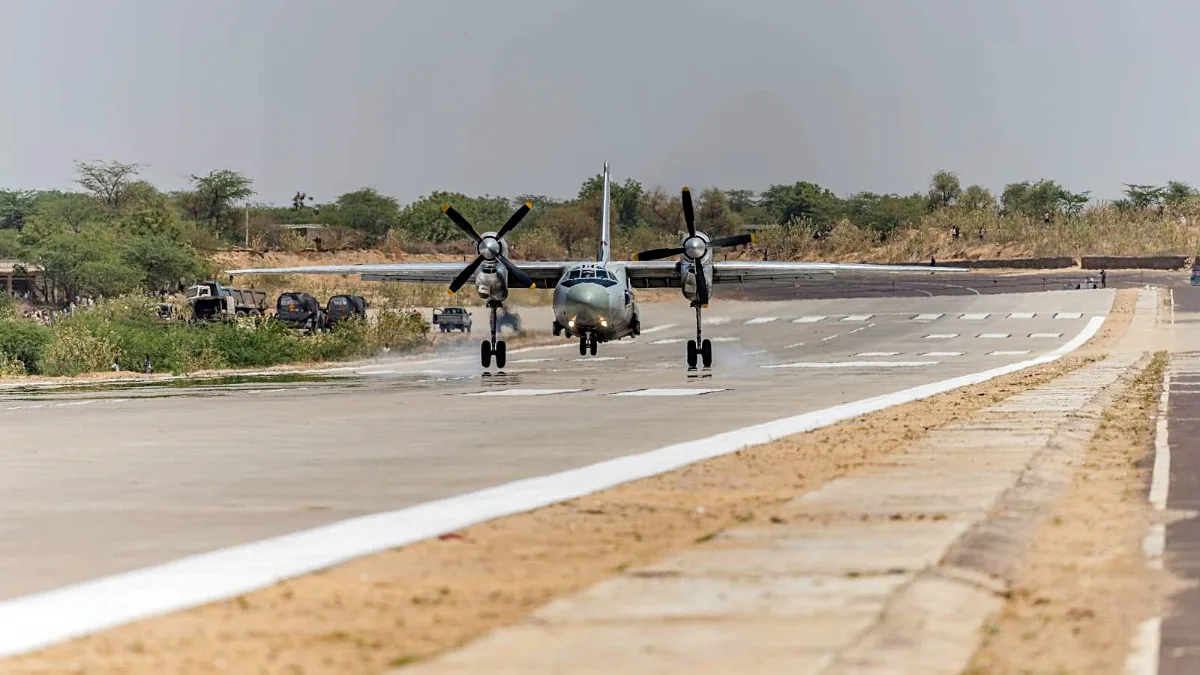
The Indian government is advancing its emergency preparedness and strategic capabilities by building new Emergency Landing Facilities (ELFs) on national highways across the country. This initiative aims to enhance the country’s ability to respond to various contingencies, including natural disasters and military emergencies.
Prime Minister Narendra Modi on Saturday inaugurated the Northeast’s first highway-based Emergency Landing Facility at Moran in Assam’s Dibrugarh district, marking a major milestone in India’s defence infrastructure. The Moran facility, the first of its kind in the Northeast, is expected to enhance the Indian Air Force’s operational flexibility, particularly in strategically sensitive regions.
Advertisement
Nationwide, India is building around 28 Emergency Landing Facilities (ELFs) to strengthen the network of road-runways, ensuring swift delivery of emergency services in a conflict scenario. This marks a strategic development that would empower the Indian Air Force to continue to fight even if an adversary succeeds in striking its major airbases. The ELF highway airstrips enhance the flexibility of air operations during contingencies and Humanitarian Assistance and Disaster Relief (HADR) operations in far-flung areas.
Strategic importance of ELFs
The ELFs are being built strategically near borders, coastlines, and other sensitive zones across the country. IAF and the Ministry of Road Transport and Highways are working jointly for the creation of ELFs at suitable locations.
Notably, the highway airstrips are equipped with basic air traffic control infrastructure and parking aprons. Reinforced concrete highway airstrips can bear the maximum take-off weight of a 74-ton transport aircraft, along with the heat of fighter-jet afterburners.
ELFs: Critical asset for emergency response
If primary bases get damaged during adverse times, ELFs can play a significant role in providing the Indian Air Force with the flexibility to disperse assets and continue operations from its highway airstrips. For instance, the Moran strip can serve as a direct backup to Chabua Air Force Station and Dibrugarh Airport, in case of an emergency situation.
ELFs also allow quick mobilisation, enabling huge aircraft to land and offload infantry platoons or light armoured vehicles, and be airborne again within minutes. Furthermore, these ELFs can also host mobile radar and communications systems when activated. They function as temporary command-and-control nodes that support surveillance and electronic warfare.
Besides wartime situations, these ELFs contribute immensely in disaster-prone regions as a crucial backup when conventional airports are flooded or cut off. The highway airstrips enable quick delivery of relief supplies and rescue teams.
All in all, the emerging network of emergency landing facilities in India will help in building resilience into India’s warfighting posture, so as to ensure that the country’s airpower remains survivable, flexible and usable even under sustained attack.